

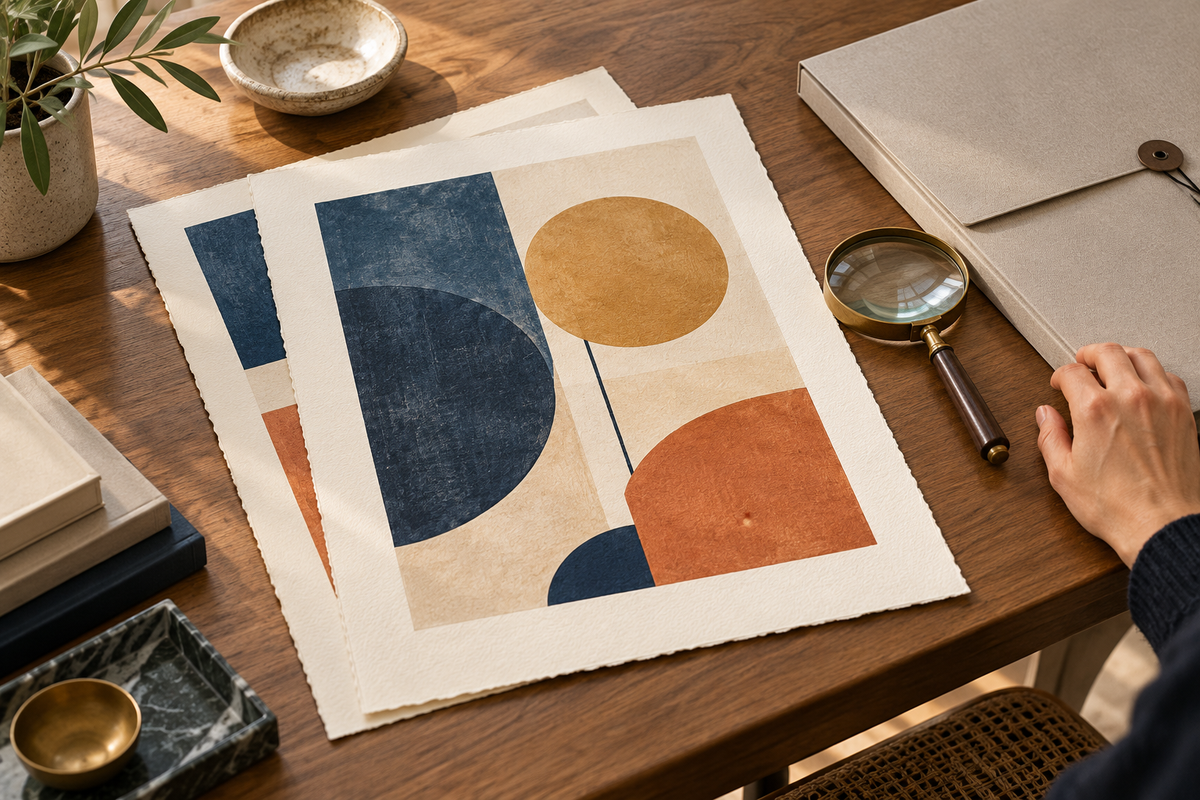
A numbered print can be a way to get closer to the work of an artist you are interested in. Before choosing, however, it is best to understand what the sheet and the inscriptions on the paper describe. The fraction next to the image is only part of the information: the technique, documentation, and condition of the copy also matter.
This guide helps you prepare specific questions for the seller and compare the answers. You do not need to recognize every process at a glance: it is more useful to know which details to ask about and which doubts to clarify before purchasing.
A print can be an original work
As explained by the Victoria and Albert Museum, a print is created by transferring an image from one surface to another through a repeatable process. The work may be conceived specifically for this medium: the presence of multiple copies does not automatically make it a reproduction of a painting.
It is therefore necessary to distinguish an original graphic work from a decorative reproduction. Ask how the work is described in the artist's or publisher's documentation, without relying solely on the appearance of the photograph or the word "print". Even a reproduction can be a conscious choice, provided the description is clear.
Lithography and screen printing indicate different processes
The National Gallery of Art illustrates the differences between the techniques. In lithography, the design is prepared on stone or plate and transferred to paper. In screen printing, the ink passes through the open parts of a fabric stretched over a frame; the screened areas prevent the color from passing through.
To orient yourself, ask the seller to indicate the exact technique and the measurements of both the sheet and the image. This data is also useful when asking for a comparison with a documented copy. A generic description such as "color print" leaves open questions that are worth resolving.
What does, for example, 25/100 mean?
Generally, the first number identifies the copy and the second the size of the numbered edition. The inscription 25/100 therefore indicates copy number 25 in the series of 100. However, this is not enough to know all the proofs that may have been produced separately.
The Sotheby’s guide to editions also clarifies a common misunderstanding: a low number does not automatically mean a higher value. Two copies from the same edition should be compared considering, among other things, their condition and provenance. The numbering is not a ranking of quality.
You may encounter abbreviations such as A.P. or E.A., referring to artist proofs outside the normal numbered series. Do not automatically attribute a surcharge to them: ask how many there are, how they are registered, and what relationship they have with the offered edition.
The signature and documents should be read together
Request a clear photograph of the inscriptions and clarify whether the signature is hand-signed or reproduced in the image. Also ask which documents accompany that specific copy, who issued them, and what information they contain.
In Print Collecting 101, Sotheby’s highlights the usefulness of comparing the work with catalogues raisonnés, technique, dimensions, and documented inscriptions. A photograph alone does not resolve authenticity: if inconsistencies emerge, a specialist examination, possibly with a direct inspection, is required.
Look at the paper too, not just the subject
Ask for information about folds, tears, color alterations, and possibly trimmed margins. The frame may hide part of the sheet: ask if there are photographs or a condition report. Do not personally remove a fragile work to perform a check.
Before deciding, gather the answers you have received on a single sheet:
- Artist, title, technique, and measurements.
- Complete numbering and any proofs outside the edition.
- Characteristics of the signature and available documentation.
- Condition of the sheet, margins, and image.
- Total price and agreed delivery method.
How to start your search on VendereQuadri
You can explore the Limited Edition selection and flag the work you are interested in through the purchase consultation. Indicate the artist, preferences, and budget, then ask for the details of the copy before confirming. The pleasure of choosing remains central; organized information helps you do so with greater awareness, without expectations of guaranteed appreciation.
Sources consulted on October 30, 2026: V&A, National Gallery of Art, Sotheby’s, and VendereQuadri pages linked in the text. Illustrative cover generated with AI; the works depicted are imaginary.


