

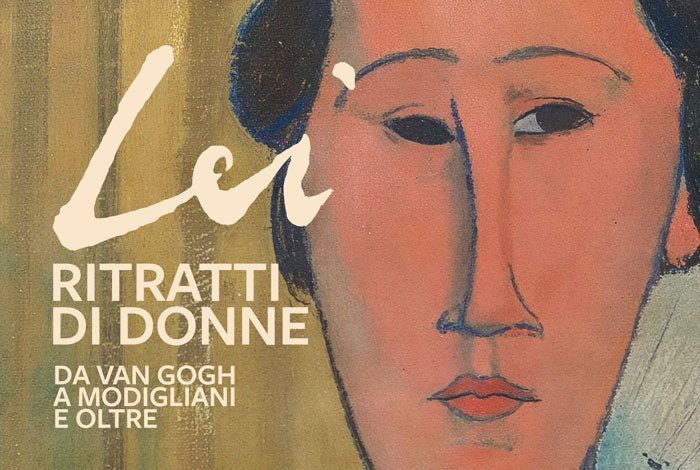
At the Palazzo del Governatore, a journey through the representation of women invites us to reflect on the distance between visibility and recognition.
Images do not merely represent the world: they help shape the way we see it. A female portrait can preserve a likeness, celebrate a presence, or pass down the memory of a person. It can also express an ideal of beauty or assign the woman depicted a specific role.
Being at the center of a work, however, has not always meant being recognized in one’s autonomy. It is from this distance between visibility and recognition that we can set out to approach “LEI. Portraits of Women, from Van Gogh to Modigliani and Beyond”, the exhibition at Parma’s Palazzo del Governatore, open from October 2, 2026, to March 8, 2027.
An opportunity to observe the works and question the gaze that traverses them: who is the woman depicted? How much do we know of her story? And what cultural expectations helped shape her image?
The LEI Exhibition at Parma’s Palazzo del Governatore
Curated by Renata Cristina Mazzantini and Cesare Biasini Selvaggi, the exhibition brings together works from the collections of Rome’s Galleria Nazionale d’Arte Moderna e Contemporanea. Paintings, sculptures, drawings, photographs, and tapestries comprise a journey through over two centuries of female representation.
Among the works on display are Vincent van Gogh’s L’Arlésienne, Giovanni Boldini’s Portrait of Marchioness Casati, and Amedeo Modigliani’s portrait of Hanka Zborowska. The exhibition also includes works by artists such as Antonietta Raphaël Mafai, Dora Maar, and Francesca Woodman, broadening the dialogue between different artistic languages and experiences.
This variety allows us to observe how the meaning of a female presence can change: a figure can be recognizable in her individuality, assume a symbolic value, or become the subject of an exploration of form and the body.
Visible, but with what voice?
For centuries, women have inhabited images as models, muses, mythological figures, allegories, and the subjects of portraits. This presence requires us to read the work while distinguishing the woman’s centrality in the artwork from the concrete conditions of the person depicted.
A painting can accord great importance to a face without revealing the desires, choices, or possibilities of the person who owns it. It can celebrate a woman while simultaneously reducing her to a shared model: beauty, motherhood, respectability, seduction.
This does not mean reading every portrait as a denial of individuality. It means recognizing that celebration and idealization can coexist. The artistic quality of an image and the cultural conventions it expresses belong to the same story and can be observed together.
What do a pose, an outfit, or a gaze tell us?
A portrait takes shape through precise decisions. The position of the body, the tilt of the head, the direction of the eyes, and the objects in the scene all help shape the meaning of the image.
An outfit can declare a social position; a setting can suggest belonging and habits; a gaze directed at the viewer can establish a direct connection. Even a seemingly spontaneous pose is the result of a compositional choice.
These elements acquire meaning within the context in which the work was created. It would be reductive to automatically attribute reserve to a figure with downcast eyes or independence to a woman looking directly at us. We must consider the painting’s intended purpose, its patron, the conventions of the period, and, when possible, the biography of the person depicted.
The question then becomes: how much are we observing that woman, and how much are we recognizing an idea of femininity constructed around her?
The Person Beyond the Representation
A painted face can convey an impression of familiarity. We may think we recognize a character, a vulnerability, or a determination. Yet what we see remains an interpretation.
Color, light, and brushwork guide our perception. An accentuated feature, an altered proportion, or a background devoid of reference points can distance the portrait from description and open it up to different meanings.
The person portrayed never entirely corresponds to the image created of her. Remembering this allows us to maintain a space of attention for what the painting cannot tell us. An absorbed expression may suggest many interpretations, but it does not, on its own, authorize us to reconstruct an inner life.
When Women Are the Artists
The reflection broadens when women also take on the role of creators of images. Through portraiture, self-portraiture, and the representation of the body, artists can confront the models they have received, adopt them, transform them, or challenge them.
However, there is no single female gaze. There are different experiences, perspectives, and inquiries. Attributing a common sensibility to all women artists would risk diminishing the very plurality we wish to recognize.
Observing who creates an image therefore helps us ask more questions: What experience informs the work? What relationship is established with the subject? What possibilities of representation are explored?
The Significance of the Exhibition on the Anniversary of Women’s Suffrage
The exhibition coincides with the eightieth anniversary of women’s suffrage in Italy. The official presentation of the catalogue links the representation of women to the themes of identity and self-determination.
This context offers another key to interpretation: distinguishing aesthetic recognition from social and political recognition. Being admired, celebrated, or remembered through a work of art does not necessarily correspond to the ability to choose how to live and how to present oneself to the world.
Visiting LEI can thus become an exercise in looking. Alongside the beauty of the works, we can search for the stories of the people, recognize the conventions, and accept the questions that remain open.
What space is granted, within the image, to the individuality of the woman depicted?
LEI in Parma: Information for Visiting the Exhibition
Exhibition: LEI. Portraits of Women, from Van Gogh to Modigliani and Beyond. Masterpieces from the Galleria Nazionale d’Arte Moderna e Contemporanea
Venue: Palazzo del Governatore, Parma
Dates: October 2, 2026, to March 8, 2027
Curators: Renata Cristina Mazzantini and Cesare Biasini Selvaggi.
For opening hours, tickets, and special openings, visit the official exhibition page on the Parma City Council website.


