

There are artists who use painting to represent the world and artists who transform it into a tool for knowledge. Mario Vespasiani belongs to the latter category. His research encompasses painting, writing, music, and photography, building a language in which symbol, nature, and memory are in constant dialogue. Rather than telling an external reality, his works invite us to explore an inner dimension, where every image becomes an opportunity for reflection.
Who is Mario Vespasiani
Born in Ripatransone in 1978, Mario Vespasiani is an Italian visual artist who has developed an independent path since his early days, characterized by continuous technical and conceptual experimentation. His first exhibitions date back to the late 1990s and, over time, his work has been presented in galleries, museums, cultural institutions, and places of worship, building a coherent path spanning over twenty years of activity.
A research that goes beyond painting
Reducing Mario Vespasiani to the role of a painter would be limiting.
His research includes writing, photography, music, and cultural design, languages that are not used as separate disciplines but as complementary tools of the same inquiry.
In this sense, every project is born from the encounter between images, words, and sounds, giving life to an experience that transcends the traditional boundaries of the work of art. Painting remains at the center of his research, but constantly dialogues with other expressive forms, expanding its meaning.
Light, symbol, and transformation
One of the most recognizable elements of Vespasiani's language is his relationship with light.
Light does not perform a purely descriptive function, but becomes a presence capable of modifying the pictorial space and suggesting meanings that go beyond representation.
Alongside it recur themes such as nature, myth, travel, memory, and transformation. These are elements that are never treated as simple figurative subjects, but as tools through which to question the relationship between the human being and the world.
His painting therefore does not seek to provide answers, but invites the viewer to build a personal dialogue with the work.
"Sing to Me, O Muse": a project that unites the arts
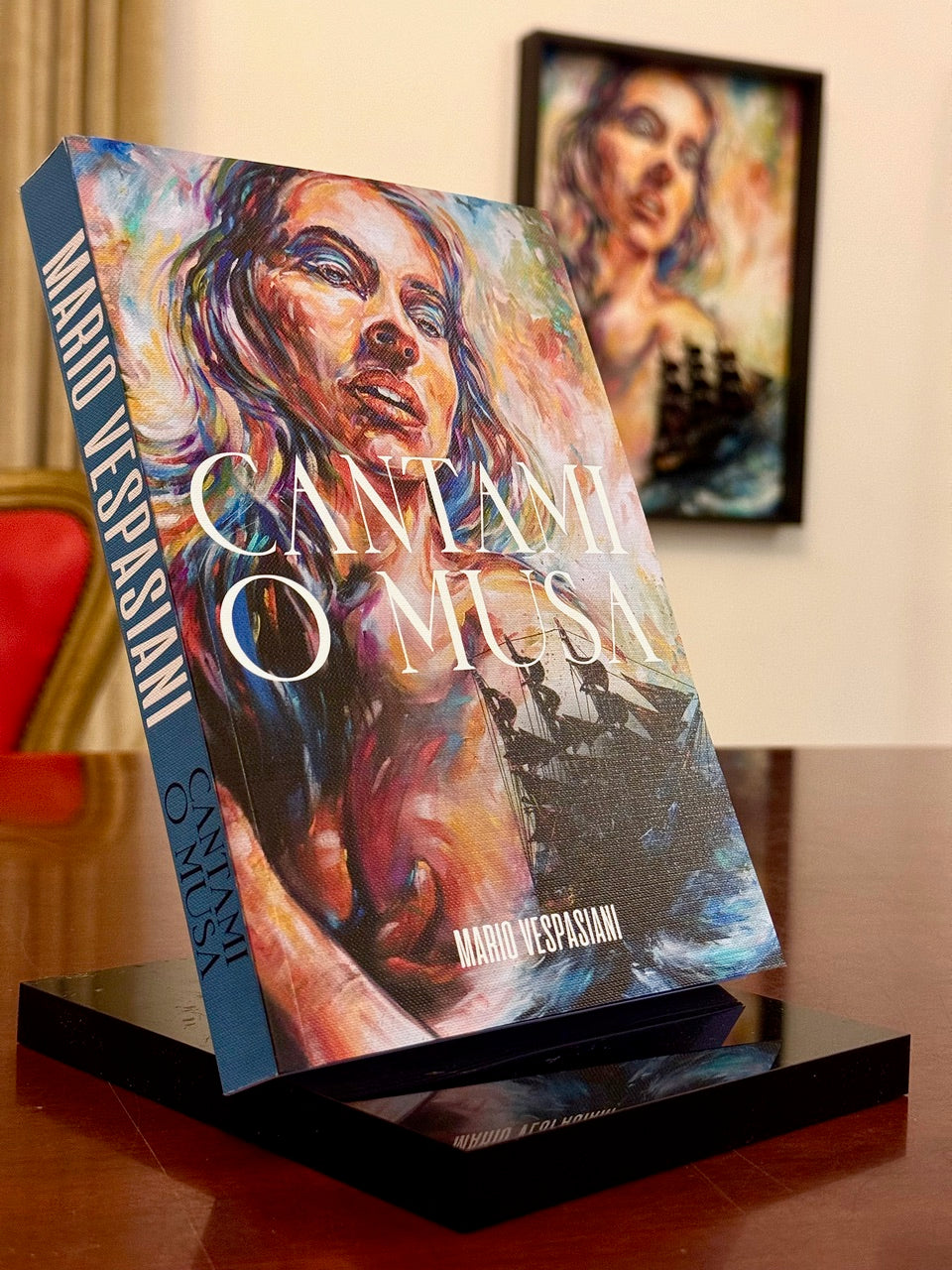
This vision emerges with particular clarity in the recent exhibition Cantami o Musa, hosted in Grottammare.
The project intertwines painting, music, poetry, and memory in a distributed exhibition path involving Palazzo Kursaal, the Fazzini Museum, and the Museum of Contemporary Illustration.
The title recalls the classical tradition of invoking the Muse as a source of inspiration, but it is reinterpreted by Vespasiani in a contemporary key, transforming it into a symbol of creativity and artistic research.
On the occasion of the exhibition, a volume was also published collecting one hundred songs composed by the artist. Painting and music do not illustrate each other, but proceed as autonomous languages that share the same cognitive tension, offering the public an immersive and multidisciplinary experience.
A continuously evolving research
What characterizes Mario Vespasiani's path is the desire not to repeat himself.
Every project represents a new chapter of a research that continues to evolve, while maintaining a strong internal coherence. Techniques, supports, and languages change over time, but constant remains the interest in the great themes of existence, in the dialogue between the visible and invisible, and in the relationship between art and experience.
It is this continuity in research, rather than belonging to a specific style, that defines the artist's identity.
Mario Vespasiani's work demonstrates how contemporary art can still be a space for reflection and knowledge.
Through a research that relates painting, writing, music, and memory, the artist builds a language capable of crossing different disciplines without losing its identity.
Rather than representing the world, his works invite us to observe it with a new gaze, reminding us that every image can become the starting point of a journey of discovery.


