

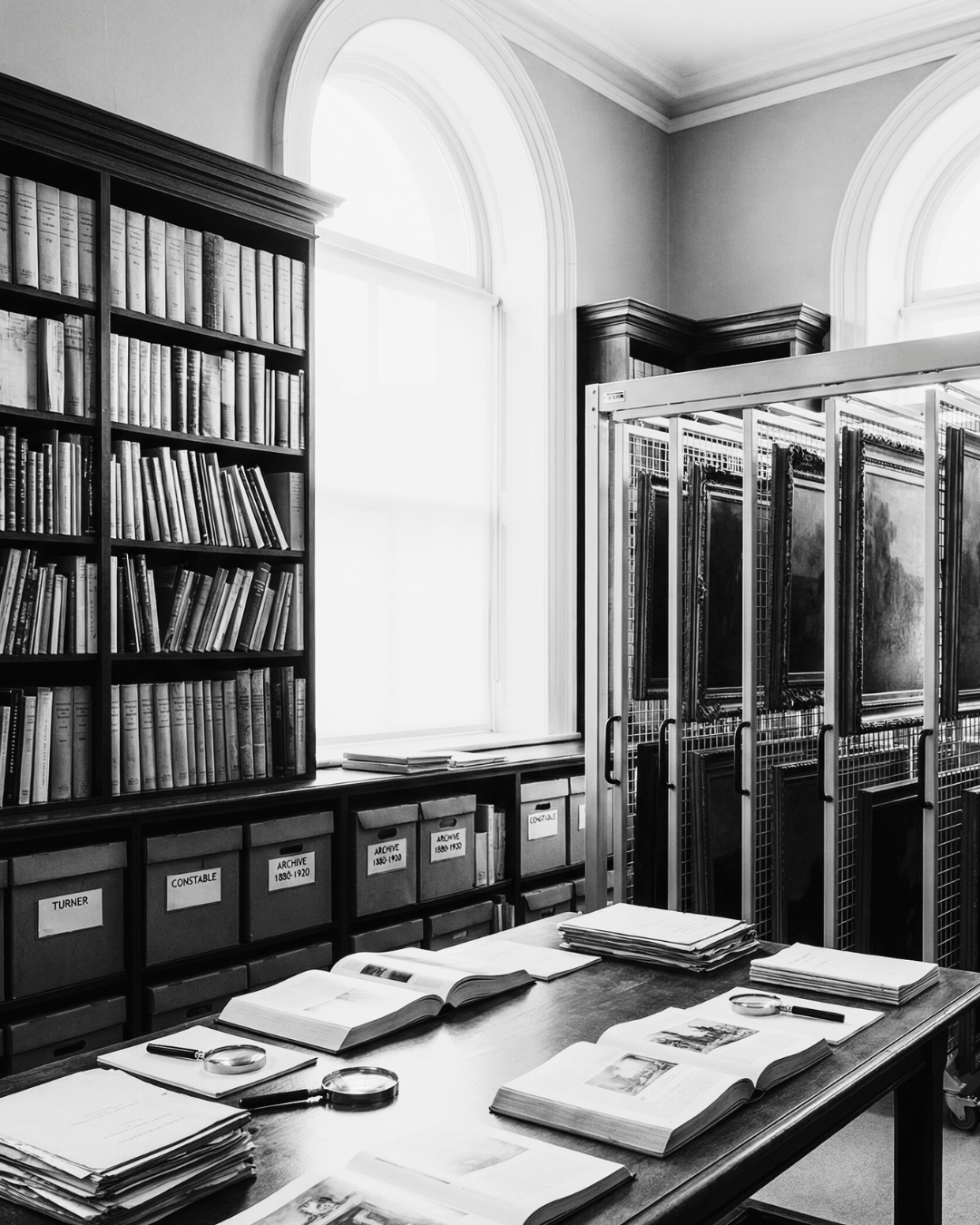
You may have already heard of archives, foundations, and artist associations. These constantly growing bodies were created to protect the intellectual legacy of the greatest artists of our time. While for ancient art, it is essential to seek the opinion of experts specialized in a specific geographical and temporal context, for painters of the twentieth century and beyond, specific institutes have been established to collect information on artists. This means we are dealing with a group of experts, sometimes even family members, who possess almost all of an artist's documentary material (diaries, letters, papers, receipts) and bibliographical material and have dedicated their lives to studying their work in all its phases. Archiving is a legal requirement for anyone intending to sell a work by an artist with a reference archive, but it is also much more. It is an act of cataloging, protection, and valorization. It's not a wasted investment, but the opportunity to officially return a work to its creator. Cataloging, in the art world, is indispensable because it allows us to reconstruct the entirety of a painter's artistic expressions, study even the lesser-known phases, and determine a series of elements intrinsic to the evolution of a figurative language. However, it is also a form of protection. If a painting were forged, the authentication (which must always accompany the work) would provide further proof of the original. If a work were stolen, the Archives have the documentation to certify that it belongs to a specific museum or private individual (since transfers of ownership are usually also traced) and help provide the documents needed for its identification and recovery. If a work were destroyed, the Archives preserve photographs that can restore its image to the scholarly community, even in the absence of the original. Archiving is also a way to enhance the value of the painting. What informed collector would ever buy a work at a high price without a document certifying its authenticity? The established collector is someone who has built up a solid understanding and market awareness and will not make the mistake of purchasing and investing large sums of money without adequate certainty: he or she will always do his or her due diligence. Because, until a work is accompanied by its certificate, it is worth nothing. It may have ethical value, but it will have no market value because it is not marketable. And this is where we also come to the legal issue. There are three main laws that regulate the art market: Article 64 of the Code of Cultural Heritage and Landscape and Articles 648 and 712 of the Criminal Code. What do these laws tell us? The art market has specific rules to protect transparency and legality. Article 64 of the Code of Cultural Heritage and Landscape Article 64 of the Cultural Heritage Code requires art sellers to provide buyers with documentation certifying their authenticity, attribution, and provenance, or a declaration with all available information. On the criminal front, Article 648 of the Criminal Code punishes receiving stolen goods, that is, the purchase or concealment of goods originating from crime for profit; those acting in the exercise of their professional activity risk more severe penalties. Finally, Article 712 of the Criminal Code concerns reckless purchasing: anyone who purchases suspect goods without verifying their legitimate provenance is punishable. In short, those operating in the sector must always guarantee traceability, accuracy, and verification of the origin of the works. In other words, if a work, whether original or not, that has a reference archive, is not accompanied by an authentication, it is not recognized by the market. It is not handled by professionals in the sector, because they would be acting in violation of the law: this poses a risk for the intermediary, seller, and buyer due to possible charges of receiving stolen goods and reckless purchasing. An unarchived painting remains a wall painting: it shouldn't leave the home; it remains anonymous and unknown. Of course, some perceive archiving as a risk, but what are the alternatives? The alternative is to expose oneself to the law and take risks, as we find confirmation online. In Ravenna, for example, a private individual attempted to sell a Schifano, which was declared a fake by the Mario Schifano Archive. The result? The work was seized by the Carabinieri of the Unit for the Protection of Cultural Heritage and a lawsuit was initiated, at the end of which the owner risks five years in prison and a €10,000 fine. Of course, submitting the work for archiving carries a certain risk: it involves an "authenticity check," and the outcome is not guaranteed. But the only alternative is to enjoy the work privately, forgotten by the broader art scene, and deny potentially authentic works the recognition they deserve.
Art. 64.1:
Anyone who engages in the business of selling to the public, exhibiting for commercial purposes, or acting as an intermediary for the sale of paintings, sculptures, graphic works, or objects of antiquity or historical or archaeological interest, or who habitually sells such works or objects, is required to provide the purchaser with documentation certifying their authenticity, or at least their probable attribution, and provenance; or, failing that, to issue, in the manner established by the laws and regulations governing administrative documentation, a declaration containing all available information regarding their authenticity, or probable attribution, and provenance. This declaration, where possible given the nature of the work or object, is attached to a photographic copy.
Art. 648:
Outside the cases of complicity in the crime, whoever, in order to procure a profit for himself or others(2), purchases, receives or conceals money or things deriving from any crime, or in any case interferes in having them purchased, received or concealed(3), is punished with imprisonment from two to eight years and with a fine from 516 to 10,329 euros [709, 712]. The penalty is increased when the act concerns money or things deriving from the crime of aggravated robbery pursuant to article 628, third paragraph, aggravated extortion pursuant to article 629, second paragraph, or aggravated theft pursuant to article 625, first paragraph, n. 7 bis. The penalty is imprisonment from one to four years and a fine from 300 to 6,000 Euro when the act concerns money or things originating from a contravention punishable by arrest of a maximum of one year or a minimum of six months(4). The penalty is increased if the act is committed in the exercise of a professional activity(4). If the act is of particular triviality, the penalty is imprisonment of up to six years and a fine of up to 1,000 Euro in the case of money or things originating from a crime and the penalty is imprisonment of up to three years and a fine of up to 800 Euro in the case of money or things originating from a contravention(5). The provisions of this article also apply when the perpetrator of the crime from which the money or things originate is not imputable [85] or is not punishable [379, 649, 712] or when a condition of prosecution relating to such crime is missing.
Art. 712:
Anyone who, without having first ascertained their legitimate origin, purchases or receives for any reason whatsoever things which, due to their quality or the condition of the person offering them or the amount of the price(1), there is reason to suspect that they come from a crime(2), shall be punished with imprisonment of up to six months or with a fine of not less than 10 Euro. Anyone who arranges for the purchase or receipt for any reason whatsoever of the above-mentioned things, without having first ascertained their legitimate origin, shall be subject to the same penalty.


